Katya Nord is a documentary wedding photographer in Berlin, working with international couples who want real, unposed moments. She had the talent and the Instagram following — but the Meta ads she ran herself weren't turning into bookings.
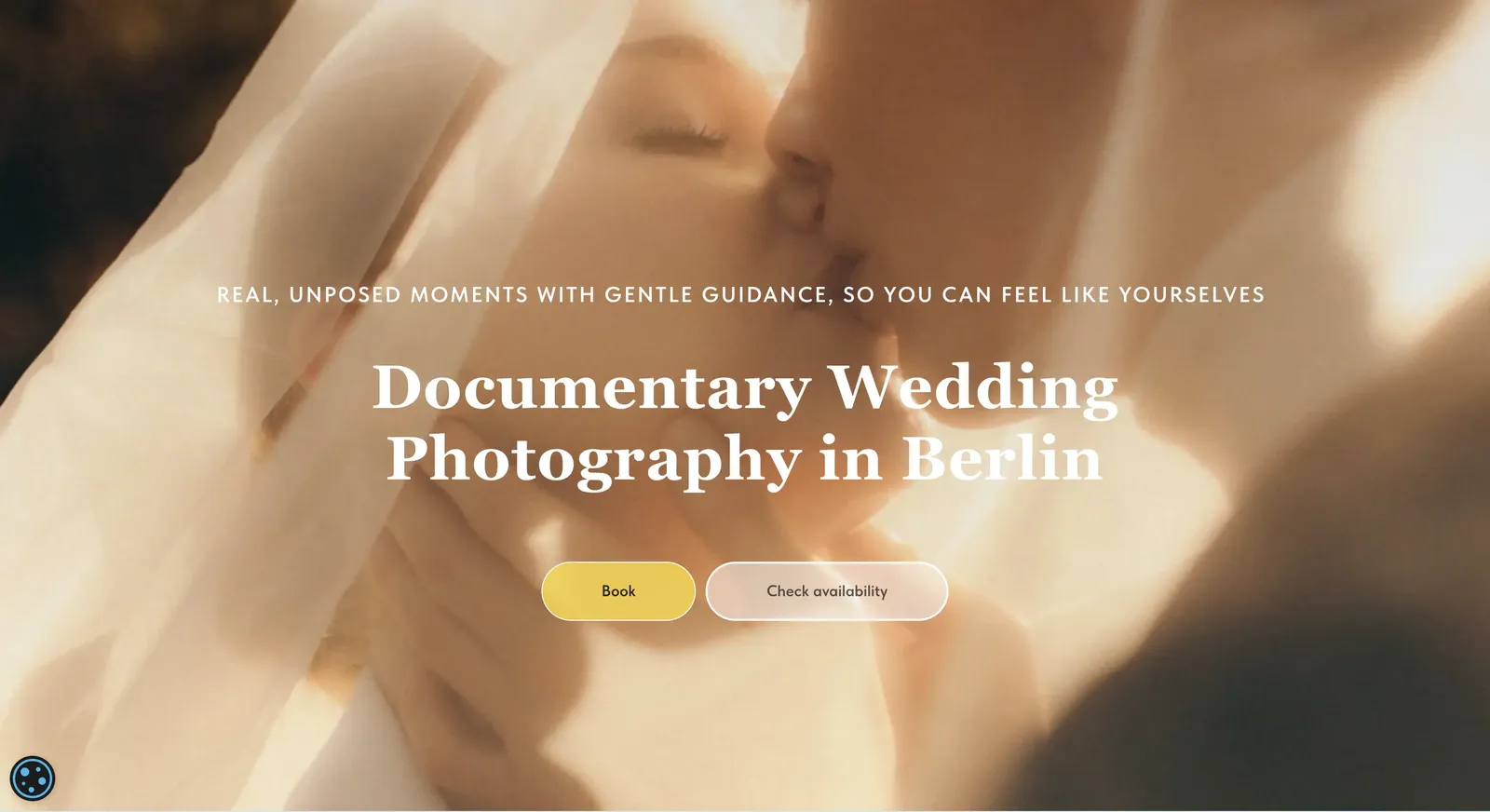
Can Meta Ads book weddings for a photographer who couldn't make ads work herself? For Katya Nord, a Berlin documentary wedding photographer, deep audience research, a conversion landing page and properly tracked Meta campaigns turned €2,271 of spend into 49 leads and €8,000 of booked weddings — with five more couples in negotiation.
Katya shoots documentary weddings — real, unposed moments with gentle guidance. Her clients are international couples, mostly 30–35, who live in Berlin and often celebrate across Europe.
She'd grown through Instagram and her first couples sessions, and had a new website — but it read like a business card, not a page that books weddings. And the Meta ads she'd run herself simply weren't producing clients.
The brief: research the real buyer, give her a page that actually sells, and run Meta properly — with tracking that finally shows what's working.
Before a single euro of spend, the job was to understand exactly who books a Berlin wedding photographer — and why they hesitate. The whole message came out of that, not out of a brand brainstorm.
Couples choose a photographer emotionally — by the visuals, the atmosphere, the personality. But they only book once they feel calm, safe and certain nothing will go wrong. Katya isn't selling documentary aesthetics; she's selling: “we get to be ourselves, no forced posing, the day stays ours — and everything important is safely captured.”
International couples, roughly 30–35, living in Berlin and often marrying across Europe. Mixed cultural backgrounds, English-speaking, aesthetically literate. They want a real, modern, “about-us” wedding — not a staged production for the relatives. First touchpoint is almost always Instagram.
Once the emotional fit is there, couples start checking for risk. Bookings stall on: no clear contract, unclear deposit and cancellation rules, no Plan B if the photographer is ill, vague delivery times, an unclear package, no full wedding gallery, opaque publishing rules, RAW-file uncertainty and no bad-weather plan. A full gallery matters most — it proves she can shoot the whole day, not just cherry-pick 15 frames for Instagram.
The trust formula: a beautiful portfolio proves taste; a transparent process proves reliability; personal presence proves it'll feel comfortable. You need all three to get the booking.
International Berlin couple who want a real party and real emotion. Fear: the photographer kills the atmosphere. Trigger: “Your day, not a photo shoot.”
Beautiful photos matter, but zero risk matters more. Fear: publishing without consent, delays, no Plan B. Trigger: “Clear process. Explicit permission. No surprises.”
Small, personal wedding; worried it'll feel empty or awkward. Fear: frozen in front of the camera. Trigger: “Gentle guidance — then space to be yourselves.”
One more split the research surfaced: German couples buy delicacy and reliability — privacy-first, clear process, no surprises. International couples buy comfort and closeness — “photos that feel like us.” Katya's audience is mostly the second, so the English-language message leads with comfort.
Her main site was a beautiful business card — not built to convert. So the brief was a dedicated, conversion-focused landing page on a subdomain, written entirely from the research. I wrote the brief — structure, message, proof, the exact objections to answer — and Katya built the page from it. Every section maps to a real fear or trust signal.
Plain client language beats art-speak. The page is built around the phrases couples actually use:
The selling landing page and her main site are both live — judge the work yourself.
View the live landing page ↗Also: katyanord.com · Instagram @katya.nord
Meta only — mostly Instagram, where these couples actually discover photographers. English-language creative aimed at international couples in Berlin (and the destination weddings they host across Europe), on a steady €33/day.
Here's the catch with this niche: few couples book straight from the landing page. They see the landing, go back to Instagram to study Katya, then DM her — or find the email on her main site and write there, or submit on the main site. Left alone, Meta would optimize blind, chasing cheap form-fills.
So every real, qualified lead — wherever it actually arrived — is fed back into Meta as an offline conversion. The algorithm learns who genuinely books a wedding, not just who clicks a form. That's what turns a thin direct-response funnel into a profitable one.
Not every lead becomes a wedding, and the research predicted exactly why. The most common drop-offs are couples who go quiet after inquiring, price mismatches, and date clashes — the structural realities of wedding photography, not a leak in the funnel.
| Metric | Result |
|---|---|
| Ad spend | €2,271 (€33/day) |
| Leads | 49 |
| Weddings booked | 6 |
| Revenue booked | €8,000 (~3.5× ROAS) |
| In active negotiation | 5 more weddings |
From €2,271 in spend: 49 leads, 6 weddings booked worth €8,000, and 5 more couples in active negotiation — roughly a 3.5× return on closed bookings alone, before the pipeline converts. A photographer who couldn't make her own ads pay now has a research-built page and a properly tracked Meta engine. The campaigns are still running.
The work wasn't prettier ads. It was understanding the buyer's real fears, building a page that answers each one, and teaching Meta — through offline conversions — who actually books a wedding rather than who fills a form.