Porten installs and replaces entry, interior and patio doors across Greater Vancouver and Vancouver Island (≈$8,000 average job). A brand-new business with no clients, no reviews and zero social proof — so the work started where it matters most: research, positioning and a conversion asset.
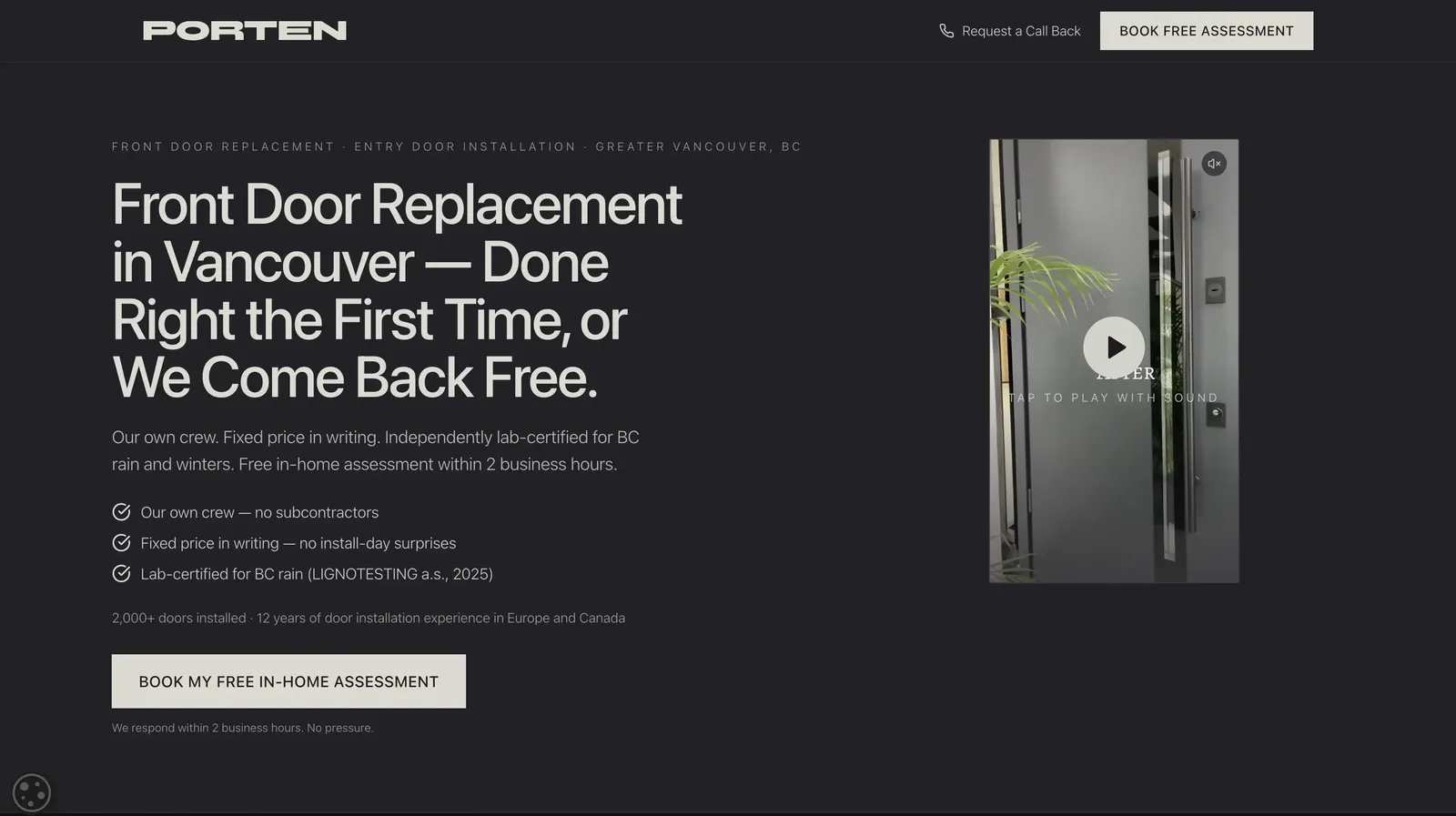
How do you launch a service business with zero reviews and no brand? For Porten, a new Greater Vancouver door-replacement company, the answer was a foundation, not a quick win: deep buyer and market research, a clear “door-first, no-surprises” position no competitor owns, and a conversion landing page. Paid ads are in testing — three qualified leads so far, in negotiation.
Porten launched with a weak business-card website — impossible to advertise or rank in search — and no clients, no reviews and no brand awareness. Zero social proof, the hardest possible starting point for a high-ticket home service.
The decision: build a proper new site (in progress, with me as project manager on structure and content) and — first — a dedicated landing page to run ads against while that site is being built.
Because there were no results to lean on, everything had to be earned by positioning and clarity. So the project began with research, not creative.
A door isn't just “disliked” — it's a daily irritation a homeowner postpones for years until a tipping point: one last shoulder-shove, water under the threshold after rain, or simply fed up. The money isn't the barrier; the risk of choosing the wrong contractor is.
47, Burnaby/East Van. Decides on intuition and reviews, not specs. Fears hidden rot behind the frame, unknown subcontractors, day-of upcharges and paper-only warranties. Convinced by names and neighbourhoods in reviews, real crew photos, certificates with numbers.
38, Coquitlam. A researcher who already watched the YouTube fix and knows it's a replacement. Came for a sticking patio door. Convinced by an RC3 certificate, a comparison table and real construction detail.
38, Coquitlam. Mobile, Instagram, 15 seconds of attention. Same patio door as Jason, but her trigger is visual: “backyard restored”, “opened it with one finger”. Price and timeline are her first questions; the form must be visible without scrolling.
More important than the physical pains are the fears that stop someone before they submit a form:
Clients rave not about the door but the consequences: “no more draft — the house is warmer”, “the slider opens with one finger”, “spotless install”, “people think we renovated the whole house — it's just a door”. The golden phrases — “slides like butter”, “like someone put a blanket on the house”, “shuts like a bank vault” — became the language of the page.
Conversion = Motivation ÷ (Friction + Risk). Peak Risk hits in the second before submitting the form — so the microcopy within 50px of the button does real work: “No deposit. No spam. We respond within 2 hours. Submitted on a weekend? We call Monday.”
BC door replacement sits inside a $103B Canadian reno sector with a rate-lock effect — people invest in the home they're not leaving. Yet the door-specific Google auction is nearly empty and door-specific SEO is uncontested. The competitor teardown found a clean split:
The one-line conclusion: those with reputation can't do digital; those with digital don't specialize in doors. Porten can own the door-first, anti-risk, “no-surprises” position — with three uncontested angles in reserve: Strata Concierge, a CleanBC rebate navigator, and aging-in-place as design.
Reviews without real names and neighbourhoods are the largest conversion gap on the whole site. “Burnaby” in a signature convinces Irina more than any certificate — a neighbourhood is social proof she can't fake in her own head. (Which is exactly why, with zero reviews today, positioning and process have to carry the load.)
With no social proof to borrow, the landing page had to lower friction and risk at every step — built straight from the research, not a template. The job: run ads against it now, while the full site is being built.
The full website is being rebuilt with me as project manager on its structure and content — the weak business-card site couldn't be advertised or ranked. (We'll cover that build here once it ships.)
The landing page is live — judge the work yourself.
View the live landing page ↗This is an early-stage case, and the numbers reflect that. Launching paid acquisition for a brand with zero reviews and no awareness is genuinely hard — there's no social proof to convert on yet. So the ads are still being tested across both channels.
| Channel (in testing) | Spend | Result so far |
|---|---|---|
| Google Ads | $1,848 | 1 lead — strong, in negotiation |
| Meta Ads | $870 | 2 qualified leads — in negotiation |
| Closed deals | — | None yet — talks in progress |
Three qualified leads, all in active negotiation, on an ≈$8,000 average ticket — from a standing start with no reviews. As the site ships and the first real testimonials (with names and neighbourhoods) come in, the conversion math gets dramatically easier. The ads keep testing and learning in the meantime.
Porten can't yet win on reviews — so it wins on being the only door-first, anti-risk, no-surprises specialist in a market where the strong players ignore digital and the digital players ignore doors. The research found that gap, and the landing page is built to occupy it.